Predicting Wall Loss Before It Happens: How CFD-Based Erosion Analysis Protects Pipeline Integrity
Bharath S. Kattemalalawadi, PhD, P.Eng., is an Associate and CFD Lead Engineer with strong expertise in fluid mechanics, heat transfer, and multiphase flow analysis. His work centers on applying advanced Computational Fluid Dynamics (CFD) to solve complex engineering problems involving piping systems, HVAC, heat exchangers, and industrial flow processes. Bharath has extensive experience in erosion and wear prediction, particle transport, transient flow behaviour, water hammer, surge analysis, cavitation, and pipe stress evaluation. He has contributed to simulation-driven studies focused on pressure drop, airflow distribution, thermal performance improvement, vibration-related flow effects, and pipeline integrity assessment. With experience across both industrial and research environments, he brings a practical and technically rigorous approach to engineering analysis. Bharath’s background supports multidisciplinary problem-solving and the delivery of reliable, high-quality solutions for demanding fluid and thermal engineering applications.
Predicting Wall Loss Before It Happens: How CFD-Based Erosion Analysis Protects Pipeline Integrity
Pipelines transporting slurry, sand-laden hydrocarbons, produced water, or mineral suspensions face highly aggressive internal flow conditions. Erosion — caused by the repeated impact of solid particles on pipe walls — is one of the most expensive and least visible integrity threats. Because erosion progresses gradually and internally, it often goes unnoticed until a rupture occurs.
Computational Fluid Dynamics (CFD) allows engineers to quantitatively predict erosion long before damage emerges. ENA2, one of the leading engineering consultants in Calgary, uses advanced Eulerian–Lagrangian CFD modelling to simulate particle motion, turbulence interactions, and wall impacts with industry-leading accuracy. The result: precise erosion maps that highlight critical thinning zones and guide design improvements.
This article explains how modern CFD predicts erosion using physics-based models and why early erosion assessment is essential for pipeline integrity management.
1) How CFD Predicts Erosion in Piping Systems
1.1 The Eulerian–Lagrangian Framework: The Foundation of Erosion CFD
CFD erosion modelling relies on two interconnected physical descriptions:
- Eulerian Continuous Phase → Solves the fluid flow field
- Lagrangian Discrete Phase (DPM) → Tracks particle motion through that field
Together, these phases allow CFD to resolve how particles accelerate, migrate, and ultimately impact pipe walls — the fundamental mechanism behind erosion.
1.1.1 Eulerian Continuous Phase (Fluid Flow)
In CFD-based erosion prediction, the Eulerian continuous phase represents the fluid (water, oil, slurry, gas, or multiphase mixture) as a smooth, continuous medium. The governing mathematical framework is based on the Reynolds-Averaged Navier–Stokes (RANS) equations, which describe conservation of mass and momentum in turbulent flow.

![]()
This solution provides:
- Velocity distribution
- Pressure gradients
- Turbulence quantities (k, ε, ω)
- Swirl and secondary flows
- Recirculation zones
- Boundary layer behaviour
- Wall shear stress
These flow structures determine how particles migrate toward walls, where they impact, and with what energy.
In simple terms:
The Eulerian phase establishes the flow environment that dictates particle movement.
1.1.2 Lagrangian Particle Tracking (Discrete Phase Model – DPM)
Once the continuous flow field is solved, particles are tracked individually using Newton’s second law:

![]()
Particles experience:
- Drag forces
- Buoyancy
- Lift forces (Saffman, Magnus)
- Turbulent dispersion
- Collision and rebound behaviour
The Lagrangian solver predicts:
- Particle trajectories
- Impact angles
- Impact velocities
- Impact frequencies
- Residence times
Because erosion depends directly on impact angle, velocity, and frequency, the Lagrangian phase is essential. It provides the detailed particle–wall interaction map needed to compute erosion rates accurately.
2) Erosion Rate Calculation
Once particle impacts are recorded from the Lagrangian tracking (i.e., for each wall cell we know how many particles hit, how fast, and at what angle), the local erosion rate is computed using semi-empirical correlations such as Oka, Finnie, or DNV RP-O501.
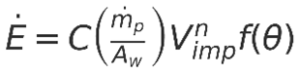
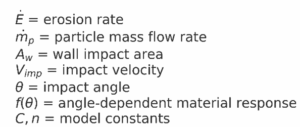
Where:
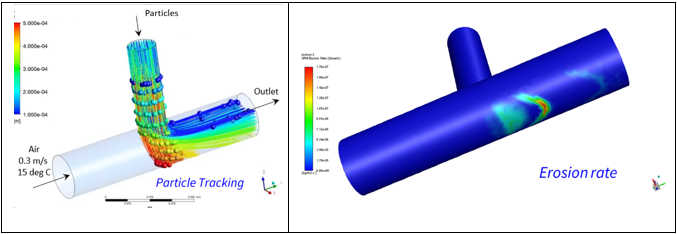
The final output is a high-resolution, geometry-specific erosion contour that highlights thinning zones in elbows, tees, valves, reducers, and fittings.
Need help evaluating erosion risk in pipelines?
For teams handling slurry, sand-laden flow, produced water, or other particle-laden systems, ENA2 provides CFD-based erosion analysis to help identify high-risk wall-loss regions and support stronger pipeline integrity decisions.
Using advanced flow and particle modelling, we help engineering teams better understand erosion behaviour in elbows, tees, valves, and other critical fittings. To learn more about our broader capabilities in simulation-driven flow analysis and engineering support, visit our CFD services page or contact ENA2 to discuss your application.
Need CFD Services for Pipeline Analysis?
CFD-BASED EROSION ASSESSMENT,
MULTIPHASE FLOW, PRESSURE DROP,
AND THERMAL ANALYSIS TO IMPROVE
PIPELINE PERFORMANCE AND INTEGRITY