
CFD Erosion Analysis for Slurry Pipe Connection
Ansys Fluent CFD study comparing coated and uncoated spoolable pipe connections under slurry transport conditions, identifying erosion-prone regions and supporting coating, liner and material decisions.
CFD-Based Erosion Assessment for a Slurry Pipe Connection
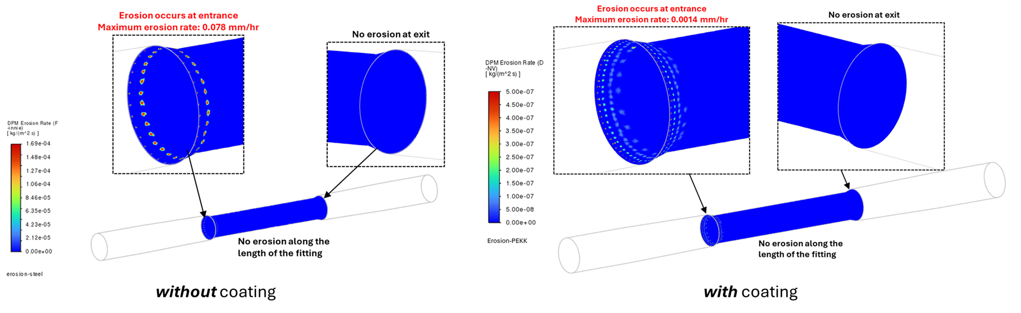
ENA2 conducted a CFD erosion study to evaluate slurry flow behaviour, particle trajectories and particle-wall interactions within a spoolable pipe connection. The analysis focused on locating erosion-prone regions in the steel fitting and transition areas under the evaluated slurry transport conditions.
The study compared uncoated and protected fitting configurations to assess differences in predicted erosion behaviour. Flow and particle-impact results informed the evaluation of coating, liner and material options for slurry transport applications. Explore ENA2's CFD erosion analysis services for related engineering applications.
From Slurry Flow Modelling to Erosion Performance Comparison
The workflow used computational fluid dynamics to model slurry flow through the connection, examine particle-wall impacts and compare the predicted erosion response of uncoated and protected fitting configurations.

Challenge, Engineering Approach & Result
Slurry-borne particles can impact fitting walls and transition regions, creating localized material loss. This assessment used CFD to identify critical exposure regions and support comparison of protective configurations.
Challenge
Slurry transport through the connection created potential erosion risk at internal fitting surfaces and transitions. The challenge was to identify erosion-prone locations and determine how protective material choices could influence the expected response.
Engineering Approach
ENA2 used Ansys Fluent to model internal flow, particle trajectories and particle-wall interactions for the evaluated conditions. The coated and uncoated configurations were compared using the assessment outputs and applicable material assumptions.
Result
The CFD study highlighted erosion-critical regions and supported a comparative review of the protected and uncoated fittings. The findings informed coating, liner and material selection considerations; actual service-life performance depends on the applicable erosion model, material properties and operating conditions.
 Industrial Manifold Stress AnalysisCoupled CFD and FEA for flow-induced fatigue risk.
 Pressure Vessel Fatigue AssessmentFEA fatigue review for a horizontal pressure vessel.
 API 579 Dented Vessel EvaluationLevel 3 FEA for pressure vessel dent integrity.
 ERW Seam Flaw Integrity StudyFracture assessment support for pipeline integrity.
 Pin-Column Connection FEANonlinear FEA for pinned structural connection behaviour.
 Composite Wall Stiffness StudyFEA study of lateral stiffness and cyclic behaviour.
CFD Erosion Analysis FAQ
Answers to common questions about CFD erosion prediction, slurry flow simulation, particle-wall interactions and protected fitting comparisons.
What is CFD erosion analysis for slurry pipe connections?
CFD erosion analysis uses computational fluid dynamics to study slurry flow, solid-particle trajectories and wall impacts that can contribute to localized erosion in fittings, transitions and connection regions.
Why is slurry erosion important in pipeline fittings?
Repeated particle impacts may cause material loss at fitting walls, taper regions and other changes in geometry. Over time, erosion can affect component integrity, maintenance needs and service reliability.
How does Ansys Fluent support erosion prediction?
Ansys Fluent can model fluid flow and particle transport, including particle impacts at walls. When suitable erosion models and material inputs are applied, engineers can estimate erosion patterns and compare operating or design scenarios.
What information is needed for CFD erosion analysis?
Typical inputs include component geometry, flow rate, carrier-fluid properties, particle concentration and size distribution, particle density, operating conditions, wall materials, coating or liner properties and erosion assessment objectives.
Can CFD compare coated and uncoated pipe fittings?
Yes. CFD can provide comparable flow and particle-impact conditions for protected and uncoated configurations. Predicted material loss also depends on the geometry, material properties and selected erosion model; a coating does not necessarily change the flow field.
What are particle-wall interactions in slurry flow?
Particle-wall interactions describe how suspended solid particles strike or rebound from component surfaces. Impact speed and angle, particle characteristics and wall material can influence predicted erosion response.
Can CFD erosion results support coating or material decisions?
Yes. CFD results can identify erosion-prone locations and support comparisons among coatings, liners and materials. Final selection should also consider material testing, applicable model assumptions, operating variability and inspection requirements.
Does ENA2 provide CFD erosion analysis in Canada and the United States?
Yes. ENA2 supports projects across Canada and the United States involving CFD erosion assessment, slurry transport, particle tracking and engineering evaluation of industrial flow components.
Need a Similar CFD Erosion Assessment?
Share your component geometry, flow conditions, slurry and particle properties, wall materials and coating or liner details. ENA2 can help define a CFD erosion assessment tailored to your slurry transport application.