
Flow-Induced Dynamic Stress Analysis for an Industrial Manifold
Coupled CFD, FEA, and FFT-based assessment used to evaluate pressure fluctuations, dynamic stress response, and fatigue risk in a tempering air manifold assembly.
Coupled CFD and FEA Assessment for Flow-Induced Fatigue Risk
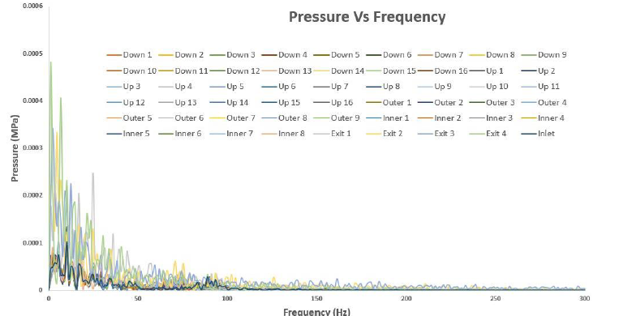
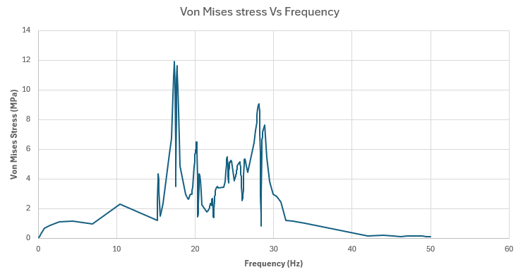
ENA2 evaluated an industrial manifold assembly where internal flow behavior and pressure fluctuations could contribute to dynamic stress and fatigue risk. CFD results were used to understand pressure-frequency behavior, while FEA was used to evaluate structural pressure response.
FFT-based post-processing helped connect transient pressure fluctuations with fatigue-relevant dynamic loading. The combined workflow supported engineering decisions related to operating conditions, structural reliability, and fatigue risk management.
From CFD Pressure Fluctuations to FEA-Based Dynamic Stress Review
The workflow connected flow simulation, frequency-domain pressure review, and structural response evaluation. This helped assess whether flow-induced pressure behavior could create fatigue-relevant dynamic stress in the manifold assembly.
Challenge, Engineering Approach & Result
Industrial manifold assemblies can experience pressure fluctuations and dynamic loading caused by internal flow behavior. This case used coupled CFD, FEA, and FFT-based review to evaluate fatigue-relevant pressure response and dynamic stress behavior.
Challenge
The manifold assembly was exposed to internal flow behavior that could create pressure fluctuations and dynamic loading. The key challenge was to evaluate whether the pressure response could generate fatigue-relevant stress conditions.
Engineering Approach
ENA2 used a coupled workflow involving CFD, FEA, and FFT-based post-processing. CFD results were used to evaluate pressure fluctuations and frequency content, while FEA was used to assess structural response and dynamic stress behavior.
Result
The analysis helped identify pressure-frequency behavior and evaluate fatigue-relevant dynamic stress response in the manifold assembly. The results supported engineering decisions related to fatigue risk, operating conditions, and structural reliability.
 Slurry Pipe CFD Erosion Study
CFD erosion study for slurry transport systems.
Slurry Pipe CFD Erosion Study
CFD erosion study for slurry transport systems.
 Pressure Vessel Fatigue Assessment
FEA fatigue review for a horizontal pressure vessel.
Pressure Vessel Fatigue Assessment
FEA fatigue review for a horizontal pressure vessel.
 API 579 Dented Vessel Evaluation
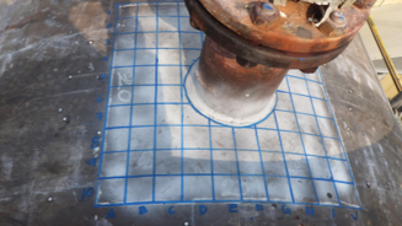
Level 3 FEA for pressure vessel dent integrity.
API 579 Dented Vessel Evaluation
Level 3 FEA for pressure vessel dent integrity.
 ERW Seam Flaw Integrity Study
Fracture assessment support for pipeline integrity.
ERW Seam Flaw Integrity Study
Fracture assessment support for pipeline integrity.
 Pin-Column Connection FEA
Nonlinear FEA for pinned structural connection behavior.
Pin-Column Connection FEA
Nonlinear FEA for pinned structural connection behavior.
 Composite Wall Stiffness Study
FEA study for lateral stiffness and cyclic behavior.
Composite Wall Stiffness Study
FEA study for lateral stiffness and cyclic behavior.
Flow-Induced Dynamic Stress Analysis FAQ
These answers explain how flow-induced pressure fluctuations, CFD and FEA coupling, pressure-frequency review, and FFT-based post-processing support dynamic stress and fatigue risk decisions.
What is flow-induced dynamic stress analysis?
Flow-induced dynamic stress analysis evaluates whether internal flow behavior, pressure fluctuations, or pulsation effects can create dynamic loading and fatigue-relevant stress response in a component or piping assembly.
Why can pressure fluctuations cause fatigue in manifolds?
Pressure fluctuations can create repeated loading cycles in manifold walls, branches, and connection regions. If the dynamic stress response is significant, these cycles may contribute to fatigue risk over time.
How are CFD and FEA used together in dynamic stress analysis?
CFD can be used to evaluate pressure behavior and flow-induced fluctuations, while FEA can assess how the structure responds to those pressure loads. Together, they help connect fluid behavior with structural stress response.
What is pressure-frequency analysis in CFD?
Pressure-frequency analysis reviews pressure fluctuation behavior in the frequency domain. It helps identify dominant frequencies, pulsation patterns, and flow-induced loading characteristics that may be relevant to fatigue assessment.
How does FFT support flow-induced fatigue assessment?
FFT, or Fast Fourier Transform, converts time-based pressure signals into frequency-domain information. This helps engineers understand dominant pressure frequencies and assess whether those fluctuations may contribute to dynamic stress or fatigue risk.
What information is needed for a manifold dynamic stress analysis?
Useful inputs include geometry, flow conditions, pressure history, operating scenarios, material data, support conditions, vibration concerns, fatigue requirements, and any available inspection or field measurement data.
Can this analysis support fatigue and reliability decisions?
Yes. Flow-induced dynamic stress analysis can support decisions related to fatigue risk, operating conditions, design changes, monitoring, inspection planning, and structural reliability under evaluated flow conditions.
Does ENA2 provide flow-induced dynamic stress analysis in Canada and the United States?
Yes. ENA2 supports clients across Canada and the United States with flow-induced dynamic stress analysis, CFD and FEA consulting, fatigue assessment, and engineering decision support for industrial components.
Need a Similar Dynamic Stress or Fatigue Assessment?
Send us your geometry, operating conditions, flow data, pressure history, vibration concerns, and available inspection details. ENA2 can help determine the right CFD, FEA, FFT, or fatigue assessment approach for your manifold or piping component.