
Pipeline ERW Seam Flaw Integrity Assessment
FEA-supported fracture assessment of crack-like electric resistance welded (ERW) seam flaws using API 579-1 / ASME FFS-1 methods and Failure Assessment Diagram review to inform pipeline integrity decisions.
FEA-Supported Fracture Assessment for Pipeline Seam Flaws
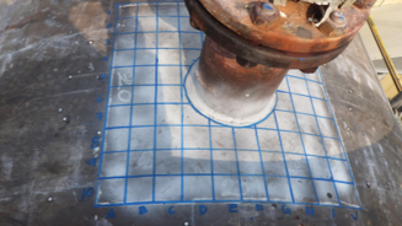
ENA2 assessed crack-like flaws associated with an electric resistance welded (ERW) pipeline seam in Alberta, Canada. Finite element analysis (FEA) supported an evaluation of local stress response and fracture behaviour using API 579-1 / ASME FFS-1 Fitness-for-Service methods.
Failure Assessment Diagram (FAD) review helped compare the assessed flaw condition with fracture and plastic-collapse limits for the evaluated loading assumptions. The results informed decisions about additional assessment, monitoring, repair planning or potential continued service. Learn more about ENA2’s fatigue and fracture analysis services.
From Crack-Like Flaw Modelling to Failure Assessment Diagram Review
The engineering workflow brought together a local flaw representation, finite element stress-response evaluation and Failure Assessment Diagram review. These steps supported comparison of the assessed condition with applicable fracture and plastic-collapse criteria.


Challenge, Engineering Approach & Result
Crack-like indications in ERW pipeline seams may affect fracture resistance under internal pressure and other service loads. This assessment combined FEA and Fitness-for-Service methods to inform an evidence-based integrity evaluation.
Challenge
The assessment required characterization of crack-like ERW seam indications and evaluation of their significance under the assessed geometry, material properties and operating stresses. Flaw acceptability could not be inferred from stress contours alone.
Engineering Approach
ENA2 used Abaqus FEA to examine the local flaw response and support fracture assessment calculations based on API 579-1 / ASME FFS-1 methods. The Failure Assessment Diagram considered fracture-driving force and plastic collapse together, subject to the assessment assumptions.
Result
The assessment provided an engineering basis for reviewing flaw acceptability and considering continued service, monitoring, pressure management, repair or further investigation under the evaluated conditions. Any final action depends on the relevant acceptance criteria and verified project data.
 API 579 Dented Vessel EvaluationLevel 3 FEA for pressure vessel dent integrity.
 Pressure Vessel Fatigue AssessmentFEA fatigue review for a horizontal pressure vessel.
 Industrial Manifold Stress AnalysisCoupled CFD and FEA for flow-induced fatigue risk.
 Slurry Pipe CFD Erosion StudyCFD erosion assessment for slurry transport systems.
 Pin-Column Connection FEANonlinear FEA of pinned structural connection behaviour.
 Composite Wall Stiffness StudyFEA of lateral stiffness and cyclic performance.
ERW Seam Flaw Assessment FAQ
Answers to common questions about ERW seam flaws, Abaqus finite element analysis, API 579-1 / ASME FFS-1 methods and Failure Assessment Diagrams for pipeline integrity.
What is an ERW seam flaw assessment?
An ERW seam flaw assessment examines defects or crack-like indications associated with an electric resistance welded pipeline seam. Engineers consider flaw dimensions, operating stresses, material properties and applicable acceptance criteria to assess potential effects on pipeline integrity.
Why are crack-like flaws important in pipeline integrity?
Crack-like flaws can concentrate stress and may promote fracture under internal pressure, residual stress, cyclic loading or other operating conditions. Their significance depends on flaw geometry, material toughness and the applied loads.
How is FEA used to assess ERW seam flaws?
Finite element analysis can represent local flaw geometry and evaluate stresses and deformations near the indication. Appropriate results may support fracture mechanics calculations and Fitness-for-Service assessments when model assumptions are validated.
What is a Failure Assessment Diagram?
A Failure Assessment Diagram (FAD) assesses fracture and plastic collapse together. It typically compares a point expressed using fracture ratio Kr and load ratio Lr with an applicable assessment curve; the interpretation depends on the selected method and input data.
How does API 579-1 / ASME FFS-1 support crack-like flaw assessment?
API 579-1 / ASME FFS-1 contains Fitness-for-Service methods for evaluating crack-like flaws, including fracture mechanics and Failure Assessment Diagram approaches. Part 9 addresses crack-like flaws; the applicable edition and assessment level must be checked for the project.
What information is needed for an ERW seam flaw assessment?
Useful inputs include inspection findings, flaw dimensions and orientation, pipe geometry, material and weld properties, fracture toughness where required, operating pressures, temperature, loading history and previous integrity evaluations.
Can this assessment support continued service or repair decisions?
Yes. An appropriately scoped assessment can inform continued-service considerations, operating restrictions, monitoring, repairs, replacement or additional inspection. It does not automatically authorize continued operation without meeting applicable requirements.
Does ENA2 provide pipeline integrity assessment in Canada and the United States?
Yes. ENA2 supports projects in Canada and the United States involving pipeline integrity, ERW seam flaw evaluations, finite element analysis and fracture mechanics consulting.
Need an ERW Seam Flaw Assessment?
Share your inspection findings, flaw dimensions, pipeline drawings, operating loads and available material data. ENA2 can help scope an FEA-supported fracture or Fitness-for-Service assessment for your asset.