
Heat Exchanger Analysis
Optimizing Thermal Performance for Critical Industrial Processes
Heat exchangers are critical components in energy, process, and HVAC systems—responsible for transferring thermal energy between fluids while ensuring reliability, efficiency, and operational safety. At ENA2, we leverage high-fidelity Computational Fluid Dynamics (CFD) simulations to evaluate and optimize the thermal and hydraulic performance of heat exchangers under real-world operating conditions. Our simulations help clients minimize pressure losses, maximize heat transfer effectiveness, and prevent failure mechanisms such as fouling, vibration, or thermal fatigue.
Specialized Heat Exchanger Modeling
We support a wide range of exchanger configurations and technologies:
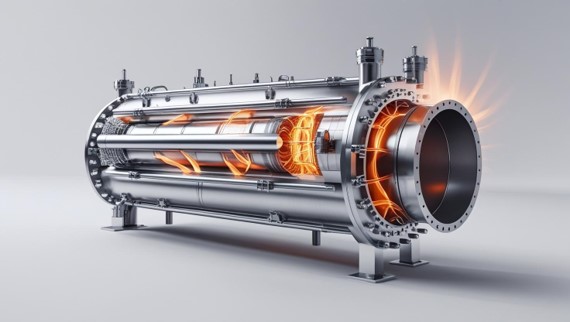
- Shell-and-Tube (TEMA standards)
- Air-Cooled Heat Exchangers (ACHE)
- Plate and Plate-Fin Exchangers
- Double-Pipe and Spiral Types
- Compact and Microchannel Exchangers
- Boilers, Condensers, and Reboilers
Detailed Flow Distribution Modeling
We simulate 3D internal flow to detect:
- Maldistribution between tubes or plates
- Bypassing, recirculation zones, or dead legs
- Flow inefficiencies due to poor header or baffle design
These insights support geometry refinement for enhanced uniformity, efficiency, and capacity utilization.


Fouling and Performance Degradation
We assess:
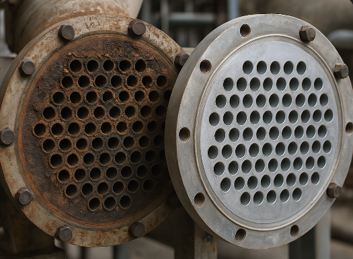
- Fouling layer formation and thermal resistance buildup
- Impact on pressure drop, heat transfer rate, and cleaning intervals
- Support predictive maintenance strategies and fouling factor-based derating
Conjugate Heat Transfer (CHT)
Coupled simulation of:
- Fluid convection in working fluids (gas, liquid, or two-phase)
- Solid conduction through walls, baffles, fins, and tubes
- Enables full thermal resistance mapping and accurate wall temperature prediction


Thermal Stresses and Structural Integrity
By integrating CFD with FEA-based thermal stress analysis, we evaluate:
- Thermal gradients and associated expansion mismatch
- Risk of cracking, fatigue, or component warping
- Design resilience against cyclic thermal loading
Boiling, Condensation, and Phase Change
We simulate two-phase heat exchangers used in:
- Power plants (condensers, evaporators)
- Refrigeration systems (vaporizers, compressors)
- Cryogenic and LNG processes
CFD captures nucleate boiling, film condensation, and phase interface movement, enabling accurate sizing and control logic development.


Hotspot and Coldspot Detection
We identify:
- Localized temperature extremes (often undetected in simplified models)
- Zones at risk for thermal stress, insulation breakdown, or inefficient heat transfer
- Uneven loading that may affect long-term reliability
Applications and Industry Use
Analysis Capabilities
We perform both steady-state and transient heat exchanger simulations to evaluate performance across different operating regimes:
Steady-State Thermal Analysis
Assessment of temperature profiles, heat duty, flow distribution, and pressure drops under nominal design conditions—essential for sizing, rating, and performance verification.
Transient Thermal Analysis
Simulation of dynamic scenarios such as startup, shutdown, thermal cycling, or process fluctuations—enabling insights into time-dependent heat transfer behavior, lag effects, and thermal stability.
Evaluation Metrics and Deliverables
Our analysis delivers actionable results that support both design and operational decisions:
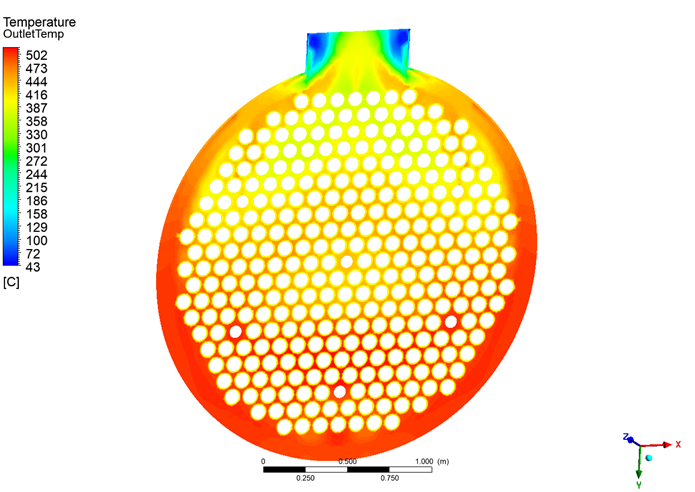
- Thermal performance maps: temperature contours, heat transfer coefficients, effectiveness
- Flow uniformity analysis and maldistribution diagnostics
- Pressure drop predictions for pump/fan selection and operational cost estimation
- Thermal stress maps and fatigue risk assessments
- Design improvement recommendations: geometry, flow arrangements, materials, or control strategies
Applications and Industry Use
By simulating real operating conditions and capturing detailed flow and heat transfer behavior, ENA2 enables clients to develop high-performance, durable, and cost-effective heat exchanger systems—fully compliant with industry standards such as TEMA, ASME, API, and ISO.