API 579 Fitness-for-Service (FFS) Evaluation
API 579 Level 3 Fitness-for-Service (FFS) Evaluation
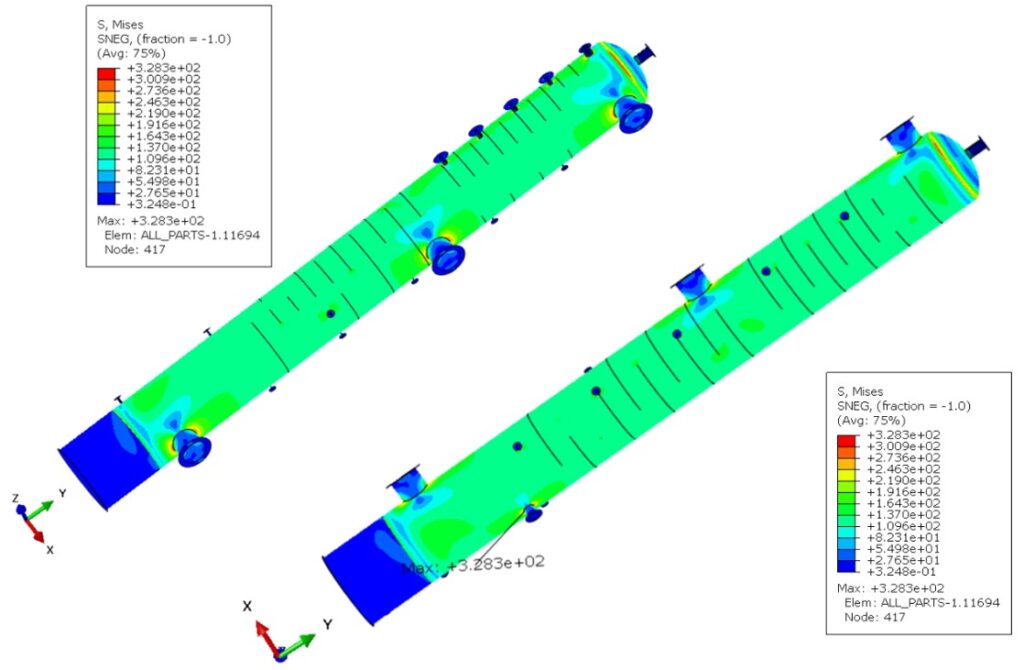
Fitness-for-Service (FFS) assessments are essential for determining whether damaged, corroded, or aged pressure equipment can continue safe operation. Following the industry-standard API 579-1/ASME FFS-1, our advanced Level 3 evaluations provide the highest degree of accuracy by leveraging Finite Element Analysis (FEA) to simulate real-world damage scenarios — including corrosion, denting, and other localized degradation.
Simulation Capabilities
Part 4 – Assessment of General Metal Loss
We apply Level 1–3 methodologies to assess large-area wall thinning using minimum thickness (t_min), required thickness (t_required), and the Remaining Strength Factor (RSF). Using grid-based UT data or corrosion mapping, we evaluate integrity under internal pressure using stress analysis and MAWP recalculations. Elastic-plastic FEA is employed when geometry or loading becomes non-standard. This ensures code-compliant serviceability for shells, heads, and nozzles experiencing uniform corrosion.


Part 5 – Assessment of Local Metal Loss
Localized wall loss near welds or structural discontinuities is assessed using either rectangular or contour evaluation zones. We compute RSF considering interaction rules for multiple flaws, applying plastic collapse criteria with stress linearization across critical sections. For complex geometries, 3D FEA with true wall profile input is used to determine limit load margins. This method is crucial for components under high local stress or pressure cycling.
Part 9 – Crack-Like Flaws Assessment
We evaluate complex, non-standard cracks such as embedded flaws, toe cracks, fusion-line defects, and seam weld anomalies. Using LEFM or EPFM frameworks, we calculate Stress Intensity Factors (K_I) and J-integrals under combined membrane and bending loads. Any crack geometry can be modeled using FEA to capture true stress gradients and local constraint effects. API 579’s fracture toughness indexing and K-solution modules are applied to determine flaw stability and support critical run-repair decisions.


Part 6 – Assessment of Pitting Corrosion
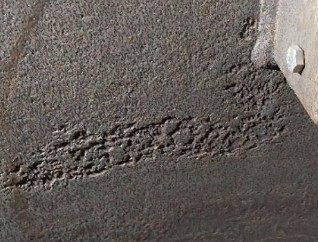
For severe pitting cases, we conduct Level 3 assessments using detailed FEA-based stress analysis. Actual pit geometry is modeled from inspection data to evaluate local stress concentration, plastic strain zones, and ligament failure risks. Material plasticity, triaxiality, and nonlinear contact near pit boundaries are considered. Elastic-plastic analysis is used to determine limit load margins and verify component fitness under design pressure and temperature. This method is ideal for pitted areas near welds, nozzles, or supports.
Part 11 – Dent Evaluation
Dent assessments focus on depth-to-diameter ratio (d/D), strain-induced stress fields, and proximity to weld seams or corrosion. We apply dent strain criteria and curvature-induced membrane stress evaluation per Part 11. For complex dent geometries, nonlinear FEA determines equivalent plastic strain zones and buckling potential under pressure or cyclic loading. Multi-dent interaction and dent-gouge combinations are evaluated using geometry scanning and finite strain metrics. Often used in pipeline and vessel integrity decisions.


Why Level 3 Evaluation?
Level 1 and Level 2 evaluations offer conservative, quick-check or semi-analytical methods. However, they have key limitations:
- Level 1 assumes simplified geometry and uses screening criteria. It is often overly conservative and may reject acceptable components.
- Level 2 involves more detailed calculations but still relies on predefined assessment curves and assumptions — unsuitable for complex geometries or interacting flaws.
Level 3 overcomes those limitations by enabling numerical simulation of actual damage under realistic loading conditions. It provides:
- Accurate stress and strain distribution using elastic or elastic-plastic FEA
- Prediction of remaining strength factor (RSF) and critical flaw size
- Simulation of complex flaw geometries, such as dents, gouges, pitting, and local metal loss
Interested in API 579 Fitness-for-Service (FFS) Evaluation?
We’re Here to Solve Your
API/ASME fitness-for-service Challanges