Non-Linear Analysis (gaps, friction, soil restraints)

Simulating Piping Behavior for Accurate Stress Prediction

Real-world piping systems rarely behave in a purely linear fashion. Support gaps, frictional resistance, directional restraints, and buried pipe-soil interactions introduce non-linear behaviors that must be accurately modeled to ensure safety and performance. At ENA2, we perform Non-Linear Pipe Stress Analysis using CAESAR II and AutoPIPE to capture these effects and deliver design solutions that reflect actual system behavior under operational and extreme conditions.

Simulation Capabilities

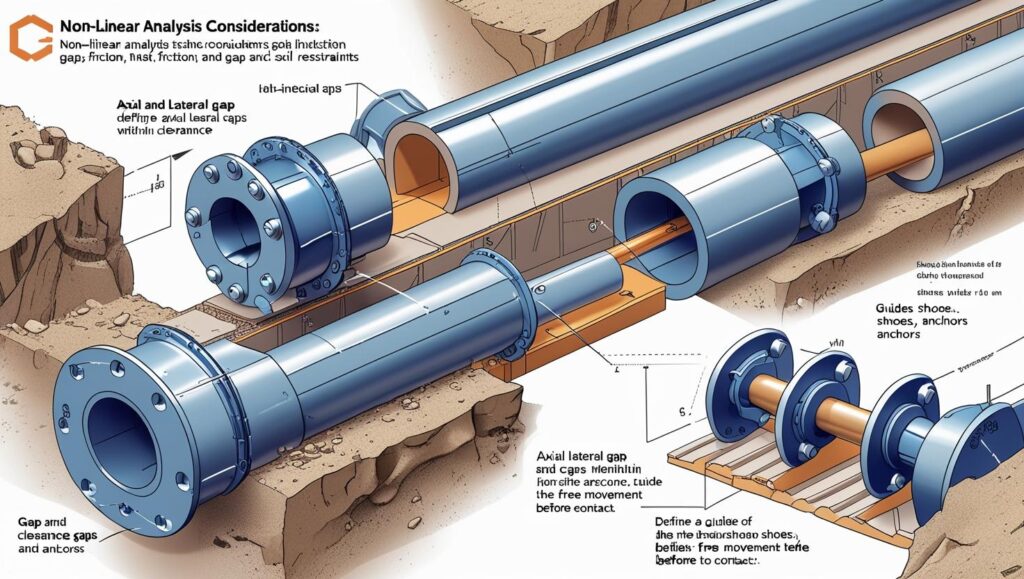
Gap and Clearance Modeling

Accurate simulation of axial and lateral gaps in support components such as line stops, guides, sliding shoes, and anchors. This allows the system to move freely within defined limits before contact occurs, enabling realistic evaluation of when and how restraints engage under different load cases, such as thermal growth or seismic displacement.

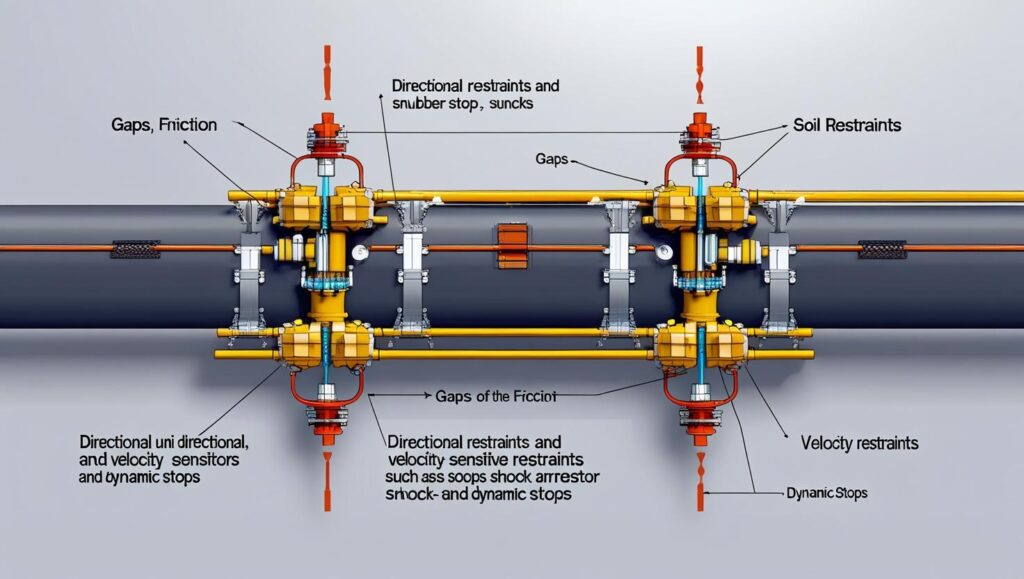
Directional Restraints & Snubbers

Modeling of direction-sensitive supports, including bi-directional, unidirectional, or velocity-activated devices like shock arrestors, snubbers, and dynamic stops. These components engage only under specific movement conditions (e.g., high acceleration or reverse motion), helping protect piping systems from sudden impact loads while remaining flexible under normal thermal conditions.

Support Friction Effects

Inclusion of friction forces in simulations of sliding supports, base plates, or pipe shoes on steel beams, using user-defined friction coefficients. This enables accurate analysis of how friction resists thermal expansion, transfers load to supports, and affects the overall stress distribution during operational movement or seismic loading.

Soil Spring & Buried Pipe Modeling

Use of non-linear soil spring elements to simulate the interaction between buried piping and surrounding soil. The model accounts for load-dependent stiffness in axial, lateral, and vertical directions—important for evaluating restrained buried segments, thermal expansion in trenches, or seismic ground movement effects.

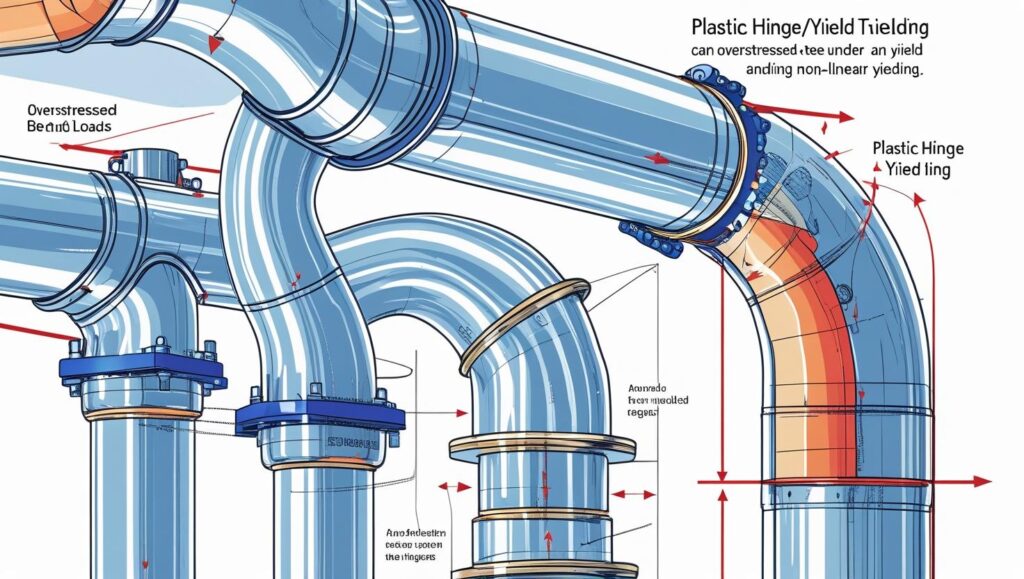
Plastic Hinge and Yield Behavior

Assessment of localized plastic deformation in piping components such as elbows, tees, reducers, and weld joints. Non-linear material behavior is considered under extreme loads, helping engineers identify potential yielding or plastic hinge formation that could compromise structural integrity. This is particularly critical for high-energy systems, blast scenarios, or post-yield evaluations.

Engineering Objectives

Our non-linear analysis services aim to:

  • Simulate Real Restraint Behavior – Capturing delayed or partial restraint engagement
  • Evaluate Frictional Effects on Thermal Expansion – Identifying where friction restricts or resists thermal movement
  • Model Soil-Structure Interaction – Accounting for passive and active resistance of surrounding soil
  • Predict Actual Load Distribution – Ensuring loads on supports, anchors, and nozzles reflect true system behavior
  • Validate System Performance Under Rare or Extreme Events – Ensuring stability during upset, seismic, or surge conditions

Why Non-Linear Analysis is Essential

Linear analysis assumes supports and restraints always engage instantly and proportionally, which isn’t realistic. Non-linear behavior becomes critical when:

  • Gaps allow free movement before restraint engagement
  • Friction resists sliding, affecting thermal growth or vibration
  • Soil stiffness restricts buried pipe movement in a non-uniform way
  • Unidirectional restraints (like snubbers or guides) activate only under specific load directions
  • Systems experience dynamic or seismic events with load reversals

Neglecting non-linear effects can lead to underestimating displacement, misjudging support loads, or overloading equipment connections.

Application Areas

Non-linear analysis is vital wherever boundary conditions deviate from idealized assumptions:

Building, Facility & Construction

Seismically Active Regions – Ensuring restraint engagement and response during rapid motion

Oil & Gas

Buried Pipelines and Risers – Evaluating soil restraint, buoyancy, and trench deformation effects

Power Generation

Large Pipe Racks with Gapped Guides – For accurate stress prediction as temperature varies

Infrastructure, Energy & Materials

Equipment Nozzle Protection – Limiting unpredictable load transfer during start-up or abnormal events

Deliverables & Insights

ENA2 provides clarity on system behavior with:

  • Support activity maps showing engagement/disengagement behavior
  • Load-deformation plots for restraints and buried segments
  • Stress and displacement plots incorporating gap and friction effects
  • Soil load distribution for buried pipe sections
  • Recommendations for gap adjustment, guide spacing, or restraint modification
  • Friction impact assessments and design alternatives

At ENA2, we go beyond idealizations to deliver realistic, safety-focused, and standards-compliant designs. Our Non-Linear Analysis service helps you confidently account for unpredictable behavior, ensuring your piping system performs not just on paper—but under real-world conditions.

Interested in Non-Linear Analysis (Gaps, Friction, Soil Restraints)?

Gain realistic insights into your piping

system's behavior with expert non-linear analysis.

Contact Us

Fill out the form below, and we will be in touch shortly.