
3D Nonlinear FEA for a Pin-Column Connection
Abaqus-based nonlinear structural assessment of a steel pinned connection under conservative seismic loading, contact behavior, local yielding, and weak-axis bending response.
Nonlinear Structural FEA for Steel Connection Design Validation
ENA2 performed a 3D nonlinear finite element analysis of a steel pin-column connection to verify structural performance under conservative seismic loading. The analysis considered realistic contact behavior, geometric constraints, local yielding, and weak-axis bending response.
The nonlinear FEA workflow helped evaluate whether the updated connection configuration satisfied the project acceptance criteria. This provided engineering support for connection design validation, seismic performance review, and structural reliability decisions.
From Nonlinear Connection Modelling to Acceptance Criteria Review
The workflow connected 3D finite element modelling, nonlinear contact behavior, local yielding review, and weak-axis bending assessment. This helped evaluate whether the steel connection configuration met the required structural acceptance criteria.


Challenge, Engineering Approach & Result
Steel pinned connections can require nonlinear assessment when load transfer, contact, local yielding, and seismic demand cannot be represented accurately with simplified linear assumptions.
Challenge
The existing connection design needed to be verified under conservative seismic loading. The key challenge was to determine whether local yielding and weak-axis bending response remained within the established acceptance criteria.
Engineering Approach
ENA2 developed a 3D nonlinear solid-element FEA model in Abaqus. The analysis included realistic contact behavior, geometric constraints, nonlinear connection response, and evaluation of local yielding and weak-axis bending demand.
Result
The nonlinear FEA assessment supported connection design validation by comparing local plastic strain and weak-axis bending response against the project acceptance criteria. The results helped determine whether the updated connection configuration was structurally acceptable.
 Composite Wall Stiffness Study
FEA study for lateral stiffness and cyclic behavior.
Composite Wall Stiffness Study
FEA study for lateral stiffness and cyclic behavior.
 Driver Cabin Impact Assessment
Explicit dynamic analysis for impact response and survival space.
Driver Cabin Impact Assessment
Explicit dynamic analysis for impact response and survival space.
 Industrial Manifold Stress Analysis
Coupled CFD and FEA for flow-induced fatigue risk.
Industrial Manifold Stress Analysis
Coupled CFD and FEA for flow-induced fatigue risk.
 Pressure Vessel Fatigue Assessment
FEA fatigue review for a horizontal pressure vessel.
Pressure Vessel Fatigue Assessment
FEA fatigue review for a horizontal pressure vessel.
 ERW Seam Flaw Integrity Study
Fracture assessment support for pipeline integrity.
ERW Seam Flaw Integrity Study
Fracture assessment support for pipeline integrity.
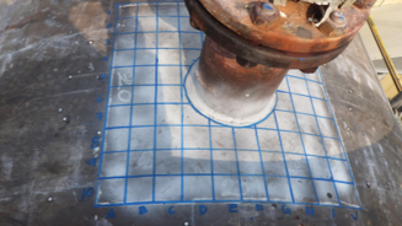 API 579 Dented Vessel Evaluation
Level 3 FEA for pressure vessel dent integrity.
API 579 Dented Vessel Evaluation
Level 3 FEA for pressure vessel dent integrity.
Nonlinear FEA Connection Analysis FAQ
These answers explain how nonlinear FEA, Abaqus contact analysis, local yielding review, and seismic design validation support structural connection assessment decisions.
What is nonlinear FEA connection analysis?
Nonlinear FEA connection analysis evaluates how a structural connection behaves when contact, large deformation, yielding, material nonlinearity, or complex load transfer cannot be represented accurately with simplified linear analysis.
When is nonlinear FEA needed for steel connections?
Nonlinear FEA may be needed when steel connections involve contact surfaces, pin behavior, local yielding, high seismic demand, complex geometry, load redistribution, or acceptance criteria that require detailed stress and strain review.
How does Abaqus support nonlinear connection assessment?
Abaqus supports nonlinear connection assessment by allowing engineers to model contact, material nonlinearity, geometric constraints, load transfer, local yielding, and detailed stress or strain response in complex structural components.
Why is contact behavior important in pinned connection analysis?
Contact behavior is important because load transfer in pinned or hinged connections can depend on surface interaction, bearing, clearance, constraint conditions, and local deformation around the pin and connected plates.
What is PEEQ in nonlinear FEA?
PEEQ means equivalent plastic strain. In nonlinear FEA, it is commonly used to review accumulated plastic deformation and assess whether local yielding remains within the project acceptance criteria.
What information is needed for a pin-column connection FEA study?
Useful inputs include connection drawings, geometry, material properties, loading conditions, seismic demand, boundary conditions, contact assumptions, design requirements, and acceptance criteria for yielding, deformation, or moment capacity.
Can nonlinear FEA support seismic design validation?
Yes. Nonlinear FEA can support seismic design validation by evaluating how a connection responds to conservative seismic loading, local yielding, contact behavior, bending demand, and deformation requirements.
Does ENA2 provide nonlinear structural FEA services in Canada and the United States?
Yes. ENA2 supports clients across Canada and the United States with nonlinear structural FEA, steel connection analysis, Abaqus consulting, seismic assessment, and structural design validation support.
Need a Similar Nonlinear FEA Connection Assessment?
Send us your connection drawings, loading conditions, material data, boundary conditions, acceptance criteria, and design requirements. ENA2 can help determine the right nonlinear FEA approach for structural connection validation, seismic assessment, or design optimization.