
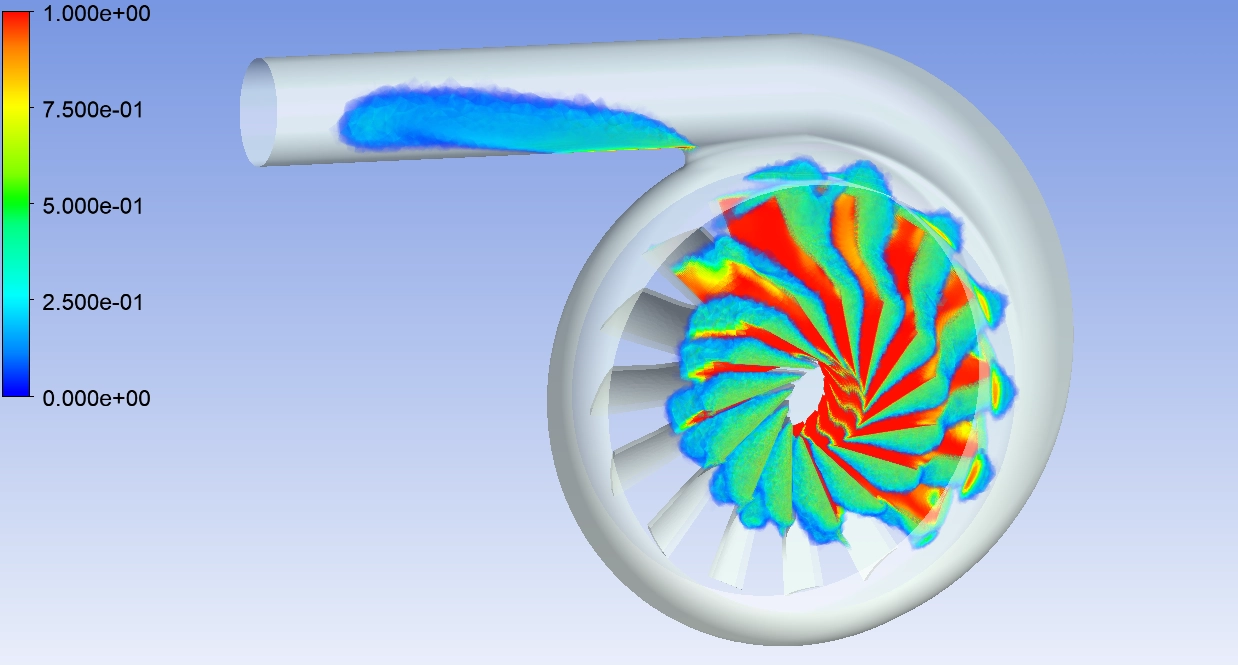
Predicting Cavitation in a Centrifugal Pump with CFD
Learn how Computational Fluid Dynamics (CFD) can help identify low-pressure regions, vapor formation, pressure drop, multiphase flow behavior, and cavitation risk inside centrifugal pumps before performance loss or component damage becomes critical.
Predicting Centrifugal Pump Cavitation Before It Becomes a Reliability Problem
Cavitation in centrifugal pumps occurs when local static pressure drops low enough for vapor bubbles to form inside the liquid flow. These vapor regions may collapse as pressure recovers, creating performance loss, noise, vibration, erosion, and potential damage to pump components.
Computational Fluid Dynamics (CFD) helps engineering teams visualize pump internal flow behavior, identify low-pressure zones, evaluate vapor formation, and assess cavitation-prone operating conditions before damage becomes visible in the field.
Identify where pressure may fall below vapor pressure near the impeller eye, blade passages, inlet, or local restriction regions.
Evaluate where vapor zones may form and how they develop under different operating points or inlet flow conditions.
Review recirculation, flow separation, turbulence, velocity distribution, and inlet distortion that may contribute to cavitation risk.
Support pump selection, operating range review, geometry improvement, maintenance planning, and performance troubleshooting.
Why Cavitation Matters in Centrifugal Pumps
Cavitation is not only a local flow issue. It can reduce pump efficiency, change the operating point, increase noise and vibration, accelerate surface erosion, and shorten equipment life. In severe cases, repeated vapor collapse may damage impeller surfaces and increase the risk of unplanned maintenance.
Cavitation risk is strongly connected to inlet conditions, pump operating range, local pressure distribution, flow acceleration, vapor pressure, and system-level pressure losses. This makes CFD valuable because it can show how internal pump flow responds before the issue becomes a physical damage pattern.
Cavitation can disturb flow through the impeller and reduce hydraulic performance across the operating range.
Vapor bubble collapse may create repeated local impacts that contribute to surface degradation and component wear.
Cavitation can contribute to unstable operation, vibration concerns, and reliability issues in pump systems.
Understanding cavitation early can help teams plan inspections, review operating limits, and reduce unexpected downtime.
How CFD Predicts Cavitation Risk
CFD can simulate the internal flow field of a centrifugal pump and highlight where cavitation is likely to occur. The analysis typically evaluates pressure distribution, velocity field, vapor volume fraction, recirculation, flow separation, turbulence, and the relationship between inlet conditions and local pressure drop.
Because cavitation involves liquid-vapor behavior, multiphase flow analysis can be especially important when vapor formation and vapor transport need to be represented in the simulation model.
Interpreting CFD Results for Pump Cavitation
Cavitation prediction is most useful when the results are interpreted as engineering evidence rather than only visual contours. Engineers review pressure fields, vapor volume fraction, impeller passage behavior, inlet recirculation, velocity acceleration, turbulence, and pressure recovery zones to understand where risk is concentrated.
In many pump systems, cavitation risk is directly connected to pressure drop analysis. Local losses, inlet restrictions, sharp turns, high velocity regions, or unfavorable operating conditions may reduce available pressure and increase the chance of vapor formation.
CFD outputs commonly reviewed for cavitation risk
- Static pressure and minimum pressure regions
- Velocity distribution and flow acceleration
- Vapor volume fraction and vapor transport
- Impeller eye and blade passage flow behavior
- Recirculation, separation, and turbulence structures
- Pressure recovery and downstream flow stability
Engineering Decisions Supported by Cavitation CFD
A pump cavitation CFD study can support decisions long before field damage becomes severe. The analysis can help teams review pump selection, inlet conditions, operating point, pressure drop, NPSH margin, impeller behavior, and potential design changes.
For existing systems, CFD findings can support troubleshooting and maintenance planning. For new designs, the same findings can help compare pump configurations, evaluate inlet geometry, and reduce the risk of performance loss after installation.
Examples of decisions CFD can support
- Operating point and pump curve review
- Inlet geometry and upstream piping assessment
- Pressure drop and local loss investigation
- Impeller passage and blade loading review
- NPSH margin and cavitation-prone condition assessment
- Maintenance, inspection, and reliability planning
Related ENA2 CFD Support
ENA2 supports industrial teams with CFD-driven pump analysis, pressure drop evaluation, multiphase flow modeling, and fluid dynamics consulting for equipment, piping, and process systems across Canada and the United States.
Evaluate internal flow behavior, pressure fields, velocity distribution, recirculation, turbulence, and flow performance in industrial equipment and piping systems.
Explore CFD Services → Pressure Drop Pressure Drop AnalysisIdentify local losses, high-velocity regions, unfavorable inlet conditions, and system-level pressure behavior that may increase cavitation risk.
Explore Pressure Drop Analysis → Multiphase Flow Multiphase Flow AnalysisModel liquid-vapor behavior, phase interaction, vapor formation, separation, mixing, and complex multiphase flow phenomena.
Explore Multiphase Flow Analysis →Need CFD Support for Pump Cavitation or Flow Performance?
ENA2 can help engineering teams evaluate pump cavitation, pressure drop, vapor formation, multiphase behavior, and flow performance using practical CFD analysis and engineering interpretation.
Pump Cavitation CFD FAQ
Answers to common questions about centrifugal pump cavitation, CFD analysis, pressure drop, multiphase flow, and pump performance simulation.
Can CFD predict cavitation in a centrifugal pump?
Yes. CFD can help predict cavitation risk by calculating pressure distribution, velocity field, vapor formation, vapor volume fraction, recirculation, and low-pressure regions inside a centrifugal pump.
What causes cavitation in pumps?
Cavitation occurs when local pressure drops low enough for vapor bubbles to form in the liquid. In pumps, this may be influenced by inlet conditions, pressure drop, high velocity regions, operating point, fluid properties, and pump geometry.
What CFD results show cavitation risk?
Common CFD outputs include static pressure, velocity distribution, vapor volume fraction, flow separation, recirculation zones, turbulence behavior, and pressure recovery regions near the impeller and pump passages.
How does pressure drop relate to pump cavitation?
Pressure drop can reduce available pressure near pump inlet or internal flow passages. If local pressure falls near or below vapor pressure, vapor bubbles may form and cavitation risk increases.
Is cavitation a multiphase flow problem?
Yes. Cavitation involves liquid and vapor phases, so multiphase flow modeling may be required when vapor formation, vapor transport, phase interaction, or vapor collapse behavior needs to be represented.
Can ENA2 support pump CFD analysis in Canada and the United States?
Yes. ENA2 supports engineering teams across Canada and the United States with CFD analysis for pump systems, pressure drop, multiphase flow, cavitation risk, and industrial fluid dynamics applications.
