Load Sequencing and Operating Case Evaluation
Simulating Real-World Piping Behavior for Accurate Stress Prediction
In complex piping systems, how and when loads are applied can significantly affect stress distribution, displacement, and equipment loading. At ENA2, we perform Load Sequencing and Operating Case Evaluation to simulate real-world loading scenarios, ensuring accurate and conservative analysis for safe and reliable system design. This analysis is critical when dealing with temperature cycles, startup/shutdown transitions, or multiple operational modes.
Simulation Capabilities

Custom Load Sequencing Definitions
Accurate modeling of how loads are applied in the real-world sequence—such as weight followed by pressure and then temperature—ensures realistic stress predictions. This also includes simulation of special conditions like cold spring application, pre-installed strain, and initial fit-up tolerances, which impact the stress distribution and pipe deflections during installation and operation.
Multiple Operating Cases
Evaluation of piping system performance across a range of design and off-design scenarios, including:
- Normal operation under full flow and temperature
- Alternate routing or flow configurations
- Standby or reduced-flow modes
- Emergency conditions, such as pump trips, blocked discharge, or failure scenarios
This comprehensive case-based evaluation ensures reliability and compliance under all possible service conditions.


Conditional Support Activation
Simulation of nonlinear support behavior, including:
- Spring supports that activate only under specific load magnitudes
- Snubbers and shock arrestors that engage during dynamic or seismic events
- Gaps or directional stops that restrict movement in certain directions
This enables precise modeling of how support components respond in each load case and prevents overestimation or underestimation of stresses.
Transient Load Path Impact
Analysis of intermediate stress states caused by the progression of loads over time. For example, a system may pass through a high-stress condition while transitioning from ambient to operating temperature. Identifying and mitigating these stress peaks is essential for avoiding fatigue damage and localized overstress failures.

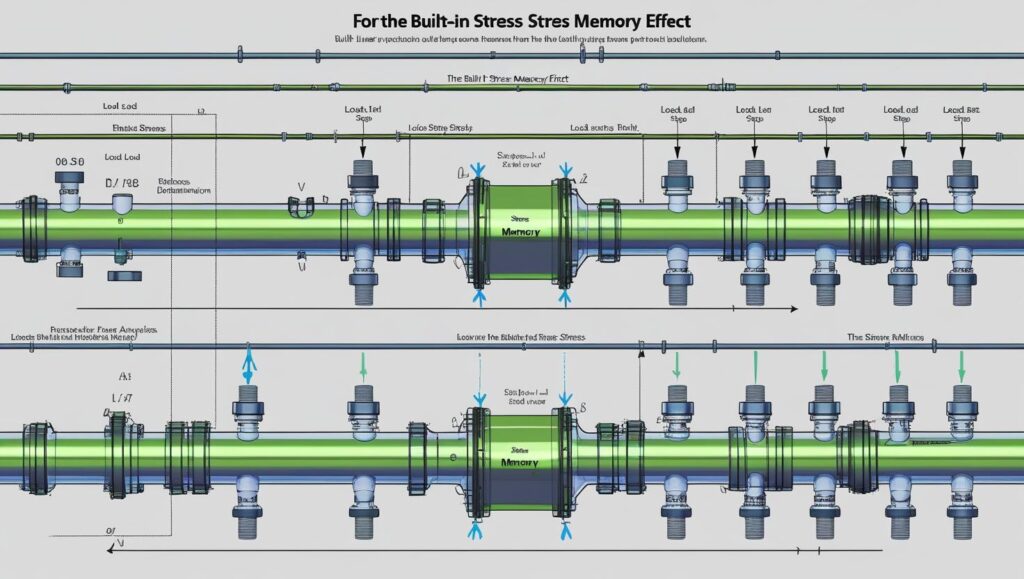
Built-in Stress Memory Effect (Load History)
The system “remembers” the impact of previous load steps, and this accumulated load history affects how it behaves under subsequent loads. This capability allows for realistic simulations of load buildup, especially important in systems with cold spring, preloaded supports, or systems that undergo cyclic loading and thermal cycling.
Importance of Load Sequencing
Unlike simplified linear assumptions, real-world systems experience sequential and conditional loading, such as thermal expansion after anchor engagement, pressure application during operation, or changes in restraints. Improper load ordering or neglecting alternate scenarios can lead to misleading stress results, nozzle overloads, or code non-compliance.
Our evaluations support:
- Realistic Load Path Assessment – Accounting for the true order of load application (e.g., weight before pressure, pressure before temperature)
- Multiple Operating Modes – Capturing system behavior across startup, shutdown, bypass, and normal operation
- Safe Expansion Behavior – Ensuring expansion joints and loops behave as expected without imposing excessive loads
- Equipment Protection – Minimizing nozzle loads during thermal transitions and partial operation cases
- Support System Verification – Ensuring supports activate/deactivate appropriately under each scenario
Application Areas
This analysis is crucial for systems with varying operational demands or sensitive equipment:
Deliverables & Engineering Insights
Our Load Sequencing and Operating Case studies deliver:
- Detailed load combination and sequencing matrices
- Stress comparison across all defined operating cases
- Displacement and support reaction variations per case
- Nozzle load envelope summaries for connected equipment
- Recommendations for support tuning or operating procedure modification
- Load path visualization and annotated plots
By aligning analysis with true operational behavior, ENA2 enables clients to avoid surprises during commissioning and operation. Our evaluations ensure robust, code-compliant designs that stand up to both expected and edge-case scenarios—helping you meet performance, safety, and reliability goals.
Interested in Load Sequencing and Operating Case Evaluation?
Ensure robust piping designs that perform
reliably across all operational scenarios.