Infrastructure, Energy & Materials Engineering Services
Simulation-led engineering services for infrastructure, energy, and materials projects, helping improve safety, code compliance, equipment reliability, and operational performance across critical industrial systems.
From cross-country pipelines and high-pressure vessels to underground mining shafts, modular skids, heat exchangers, silencers, and heavy-duty process equipment, today’s infrastructure is expected to operate longer, perform more safely, and withstand increasingly demanding service conditions. At ENA2, we support infrastructure, energy, and materials projects with advanced engineering simulation services that validate critical assets before fabrication, installation, and field deployment. Our analyses help improve structural integrity, thermal performance, flow reliability, and long-term operational confidence.
Using Finite Element Analysis (FEA), Computational Fluid Dynamics (CFD), and Discrete Element Modeling (DEM), we help engineering teams evaluate real-world challenges such as thermal expansion in piping systems, fatigue near nozzle welds, flow-induced vibration in silencers and ducts, particle wear in chutes and hoppers, and structural response under pressure, temperature, vibration, and cyclic loading. Our goal is to deliver physics-based engineering insight that reduces development cycles, mitigates technical risk, and supports code-compliant designs from fabrication through field operation.
Through our engineering consulting services in Canada and the United States, ENA2 supports infrastructure, energy, and industrial teams with simulation-led analysis for pressure equipment, piping systems, bulk material handling, thermal systems, and heavy process equipment.
WHAT WE DO
At ENA2, we help infrastructure, energy, and industrial teams validate the structural, mechanical, thermal, and fluid performance of critical assets before they are built, installed, or deployed. Our work supports multiple sectors and a wide range of critical equipment systems, from pipelines and pressure vessels to skids, hoppers, silencers, ducts, and bulk material handling systems.
Oil & Gas
Stress evaluation, code compliance, and design validation for pipelines, pressure vessels, separators, heat exchangers, modular skids, stacks, flare systems, and related oil and gas equipment. We use coupled Computational Fluid Dynamics (CFD) and Finite Element Analysis (FEA) to assess flow instability, vibration, thermal loading, acoustic behavior, and structural response under real operating conditions.
Mining
Structural durability, fatigue life assessment, and vibration analysis for excavation equipment, bulk handling systems, and mining support structures, along with ventilation and HVAC airflow simulation for tunnels, shafts, enclosures, and underground facilities. We also perform erosion and wear modeling for slurry systems, dust-laden flows, chutes, and material handling equipment.
Power & Utilities
Thermal and structural simulation services for heat transfer systems, engine enclosures, cooling units, silencers, exhaust ducts, and utility-related process equipment. We evaluate high-temperature cyclic loading, thermal expansion, vibration behavior, and airflow performance in control rooms, substations, and power generation support systems.
Heavy Infrastructure & Processing Equipment
Multiphysics validation of bins, hoppers, silos, modular equipment foundations, and heavy processing systems. We address pipe-soil interaction, seismic anchorage, lifting and transport loads, structural support behavior, and flow uniformity in process layouts to improve reliability and field readiness.
Across all sectors, our engineering simulations are aligned with ASME, API, CSA, and applicable local regulatory requirements, helping ensure assets perform reliably under real-world pressure, temperature, vibration, flow, and structural loading conditions.
HOW WE DO IT
We start by understanding project constraints such as field conditions, design intent, load cases, operating environments, regulatory codes, fabrication requirements, installation realities, and transient operating scenarios. We then apply the right simulation methods to evaluate structural behavior, pipe stress, fluid flow, thermal response, vibration, erosion, fatigue, and system interaction so project teams can make better engineering decisions with less uncertainty.
FEA (Finite Element Analysis)
Our FEA services use nonlinear, dynamic, thermal, and fatigue-based simulation to evaluate structural response under pressure, weight, wind, seismic loading, thermal expansion, vibration, and cyclic service conditions. From nozzle stress in pressure vessels to support behavior, anchor pullout, skid frame stiffness, and structural hot spots, we validate components against real-world loading to improve safety, reliability, and structural integrity.
CFD (Computational Fluid Dynamics)
Our CFD analysis services evaluate pressure surges, multiphase flow, heat transfer, pressure drop, airflow distribution, flow-induced vibration, and fluid-structure interaction in pipes, ducts, silencers, process equipment, and ventilation systems. These analyses help optimize flow paths, reduce erosion and vibration risks, and improve thermal and operational reliability.
DEM (Discrete Element Modeling)
For particulate and bulk material systems, we apply Discrete Element Modeling (DEM) to simulate flow behavior, particle impact, abrasion, segregation, and sedimentation. Our DEM studies support the design and validation of chutes, conveyors, cyclones, dump hoppers, transfer points, and other bulk handling equipment to improve safe and efficient material flow.
Coupled Simulations
For complex systems such as slurry pipelines under dynamic loading, pressure systems experiencing thermal and structural interaction, or equipment enclosures where heat, vibration, and airflow interact, we use coupled and multiphysics simulation to capture the relevant physical effects within one engineering model.
Code Compliance, Standards, and Stamped Engineering Support
Every analysis is documented for traceability, technical review, and code compliance, including ASME Section VIII, ASME B31.3, API 579, WRC 107/297, CSA Z662, and other applicable standards. Where required, we also support PE stamping in the United States and P.Eng. stamping in Canada for relevant engineering documentation and approval workflows.
At ENA2, simulation is not only used to solve technical problems. It is used to help design infrastructure, energy systems, and industrial equipment that are robust, code-compliant, and ready for real operating conditions.
Fatigue, Erosion & Corrosion Analysis for Asset Reliability
From elbow erosion in slurry lines to fatigue cracking in tank supports, many failures begin where physics is least forgiving. ENA2 performs advanced fatigue life assessments, crack propagation simulations, and erosion and corrosion modeling using coupled CFD and FEA. Our insights help optimize thickness, material choice, and geometry—extending asset life and reducing unexpected downtime across pressure systems, chutes, impellers, and structural frames.
Above-Ground and Buried Pipe Systems That Perform Reliably
Consider a high-pressure pipeline stretching through seismic zones and under urban crossings. At ENA2, we simulate critical scenarios ranging from ground interaction and ovalization to thermal bowing, surge loading, and transient flow events. Our analyses help keep pipe stress within allowable limits under ASME and CSA code requirements while accounting for support movement, nozzle loads, buried conditions, water hammer, and slug flow. This supports safer operation and helps reduce the risk of vibration, buckling, fatigue, or failure.
Pressure Vessel and Heat Exchanger Analysis by Design
Pressure vessels and heat exchangers must withstand a complex mix of internal pressure, external loads, and temperature variation. We simulate these combined stresses—verifying code compliance (ASME VIII), analyzing nozzles and support saddles, and detecting localized overstress. For heat exchangers, we also model thermal gradients, expansion constraints, and baffle behavior to ensure long-term performance under both steady and transient flow conditions.
Skid Packages Optimized for Field Conditions
Modular equipment skids must survive transport, lifting, and in-service vibration. ENA2 provides detailed FEA to assess base frame stiffness, support layout, and equipment integration—whether you’re crane-lifting a compressor module or forklift-moving a filtration system. We simulate rigging scenarios, anchor checks, wind loading, and resonance issues, ensuring structural integrity during every phase from yard to site.
Ventilation and Airflow Analysis for Underground and Industrial Facilities
In mining ventilation systems or process HVAC setups, poor airflow can jeopardize safety and system efficiency. We use CFD to simulate airflow in tunnels, shafts, and ductwork—identifying stagnant zones, pressure drops, and ventilation imbalances. Whether you’re optimizing fresh air circulation in an underground mine or airflow distribution in a remote control room, our models help ensure compliance, thermal balance, and breathable conditions where it matters most.
Acoustic Performance Backed by Simulation
Silencers, stacks, and exhaust ducts must not only meet noise regulations—they need to resist vibration and failure over time. ENA2 blends acoustic simulation with mechanical analysis to predict tonal noise, flow-induced vibration (FIV), and acoustic-induced vibration (AIV). Whether tuning baffles in a gas-fired plant silencer or designing a rooftop stack for quieter operation, we validate every element for both sound and structure.
Common Engineering Challenges We Help Solve
Infrastructure, energy, and materials projects often involve complex interactions between structural loading, thermal behavior, fluid flow, vibration, fatigue, and operating transients. ENA2 helps teams evaluate these problems early so they can improve reliability, safety, and performance before fabrication or field deployment.
- Thermal expansion and support loading in piping systems
- Nozzle stress and equipment connection loads in pressure systems
- Flow-induced vibration in silencers, ducts, and process piping
- Fatigue, erosion, and corrosion risks in harsh service environments
- Pressure vessel and heat exchanger overstress under combined loading
- Bulk material flow, segregation, and wear in hoppers, chutes, and handling systems
- Buried pipe response under soil interaction, ovalization, and surge loading
- Ventilation, airflow imbalance, and thermal control issues in underground or industrial spaces
Typical Assets and Systems We Support
Our simulation-led engineering support is commonly applied to:
- Pipelines and buried piping systems
- Pressure vessels and separators
- Heat exchangers and thermal equipment
- Modular skids and equipment packages
- Silencers, exhaust ducts, and stacks
- Tanks, supports, and structural frames
- Hoppers, chutes, silos, and conveyors
- Underground ventilation and airflow systems
Engineering Case Studies for Infrastructure, Energy & Materials
Explore ENA2 engineering case studies showing how FEA, CFD, fatigue assessment, asset integrity review, dynamic stress analysis, and simulation-led engineering support safer and more reliable industrial systems.
Asset Integrity
API 579 Part 12 Evaluation of Dented Pressure Vessel
Fitness-for-service review for dented pressure equipment.
Fatigue Assessment
Fatigue Life Assessment of a Blow-Case Pressure Vessel
Stress and fatigue assessment for pressure equipment reliability.
Dynamic Stress
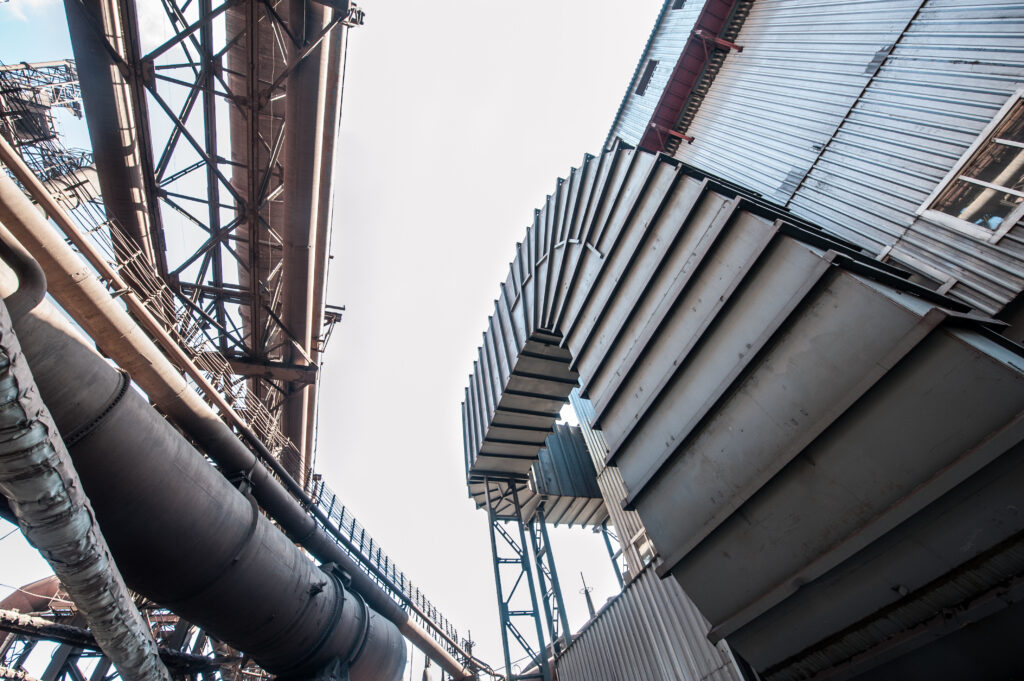
Flow-Induced Dynamic Stress and Fatigue Analysis of an Industrial Manifold Assembly
CFD-informed dynamic stress and fatigue review for flow systems.
Nonlinear FEA
3D Nonlinear FEA Analysis of Pin-Column Connection
Connection behavior review under nonlinear structural response.
Structural FEA
Improving Lateral Stiffness of Composite Wall Systems Through Vertical Reinforcement
FEA validation for stiffness improvement and structural performance.
Impact Analysis
Frontal Impact Assessment of Driver Cabin in Bus Structure
Structural safety evaluation for impact-driven loading.
Infrastructure, Energy & Materials Engineering FAQ
Find answers to common questions about pipelines, pressure vessels, heat exchangers, skid packages, CFD, DEM, pipe stress, surge, vibration, fatigue, erosion, corrosion, and simulation-led engineering for infrastructure, energy, and materials projects.
Common assets include pipelines, pressure vessels, separators, heat exchangers, modular skids, silencers, ducts, hoppers, chutes, silos, structural supports, and underground ventilation systems. These assets often require structural, thermal, flow, vibration, and fatigue evaluation under demanding operating conditions.
These analyses are important when components are exposed to repeated loading, turbulent flow, abrasive media, corrosive service conditions, or long-term operating stress. Typical applications include slurry lines, elbows, chutes, impellers, tank supports, structural frames, and pressure-containing systems. They are especially important in abrasive mining operations where wear, erosion, and material movement can affect equipment reliability.
Pressure vessel and heat exchanger analysis typically evaluates internal pressure, external loads, nozzle forces, thermal gradients, support reactions, localized overstress, and expansion-related effects. The goal is to improve structural integrity, code compliance, and long-term operating reliability. These evaluations are commonly required for oil and gas projects involving vessels, exchangers, separators, and pressure-containing equipment.
Skid package and support system analysis evaluates base frame stiffness, lifting and transport loads, anchor behavior, vibration response, wind loading, and equipment interaction. This helps confirm structural integrity during fabrication, transport, installation, and in-service operation.
CFD can help evaluate pressure drop, heat transfer, multiphase flow, airflow distribution, flow-induced vibration, erosion-prone regions, and fluid-structure interaction in pipes, ducts, vessels, silencers, ventilation systems, and process equipment. These analyses help improve flow reliability, thermal performance, and system efficiency, including applications in power generation systems.
Flow-induced vibration and acoustic-induced vibration become critical when process systems such as silencers, ducts, stacks, piping, and related equipment are exposed to high-velocity flow, pulsation, or tonal excitation. These effects can lead to fatigue damage, excessive vibration, and long-term reliability issues if not evaluated early.
DEM helps evaluate particle flow, impact, abrasion, segregation, sedimentation, and transfer behavior in hoppers, chutes, conveyors, cyclones, dump hoppers, and other bulk handling systems. This improves material flow reliability, reduces wear, and supports safer equipment performance. These studies are often valuable for mining engineering support involving bulk material handling and abrasive transfer systems.
Pipe stress analysis considers sustained, thermal, occasional, and displacement-related loads in above-ground and buried piping systems. Depending on the application, it may also include support movement, nozzle loads, soil interaction, ovalization, surge loading, and other conditions that affect flexibility and structural performance. These evaluations are commonly part of oil and gas engineering support for process piping and pipeline-related assets.
Surge or water hammer analysis is needed when rapid changes in flow may create damaging transient pressures in liquid-filled piping systems. Common triggers include pump startup or shutdown, valve closure, check valve slam, power failure, vapor cavitation, and column separation.
Simulation-led engineering helps teams improve asset reliability, reduce failure risk, optimize material use, strengthen code compliance, and make better decisions before fabrication or field deployment. It also helps teams understand how systems will behave under real pressure, temperature, vibration, flow, and operating conditions across oil and gas, mining, and power generation environments.
Need FEA, CFD, DEM, Pipe Stress or Asset Integrity Support?
Send us your drawings, operating conditions, piping data, process information, equipment details, or reliability concerns. ENA2 can help define the right analysis path for FEA, CFD, DEM, pipe stress, surge, fatigue, vibration, or asset integrity before issues become costly in fabrication, operation, or field deployment.